BATH HOTEL
The Birthplace of Caribbean Hospitality
This special online exhibition was made possible by a generous grant from the
US Ambassadors Fund for Cultural Preservation
through the Embassy of the United States of America in Bridgetown, Barbados


Built by enslaved Africans, the building known today as the Bath Hotel was, in its early years, more commonly called the Bath House or Bath House Hotel – names that reflect its original purpose and its close relationship with the hot spring that flows beneath it. The first known use of the word “hotel” appears in an advertisement from October 1823. In the 1840s it was promoted as the “Bath House”; by the later 1850s it was declared as the Bath-house Hotel; and in the 1880s on visitor referred to it as both “hostelry” and a “hotel”, while calling the smaller, two-storey building below it the bathhouse.
For generations, popular histories have described the Bath Hotel as the oldest hotel in the Caribbean, traditionally claiming it was built by John Huggins in 1778 and that it welcomed notable figures. Recent research now shows the building to have been constructed several decades later than this commonly cited date, it is nonetheless still regarded as the oldest surviving purpose-built hotel in the Caribbean, representing an early and exceptional example of hospitality architecture in the region.
A key piece of evidence is a memorial inscription in St. Pauls’ Church, Charlestown which credits John Huggins with becoming proprietor of the nearby hot springs and, “not many years before his death”, erecting convenient baths and “a large & expensive stone edifice for the accommodation of invalids.” This wording strongly suggest that the major construction took place in the 1810s or early 1820s, rather than the late 1700s.
The scale and solidity of the complex – its terraces, staircases, arched roofs, and thick masonry walls – reflect the skill, knowledge, and labour of enslaved African builders. Their craftsmanship endures in the stonework that still defines the site today and stands as a powerful testament to the resilience, expertise, and unacknowledged lives.
This exhibit invites you to encounter Bath Hotel not as a single story, but as a place where many histories meet: a spring that shaped early colonial routes and settlement ambitions; a spa designed for healing and convalescence; an early experiment in Caribbean tourism promoted by a woman entrepreneur; and – centrally – a monumental structure built by enslaved Africans, whole skilled labour continues to shape one of Nevis’s most historic sites.

bath hotel over the years
The Bath Hotel, built from hand-cut volcanic stone and lime mortar, is three stories high, surrounded on each floor by verandas with wide windows. The ceilings are more than 20ft. in height, doors 9ft 2in. in height, with massive internal chambers and internal staircases. The upper and middle floors are 6,714 sq. ft., while the lower floor is 1,200 sq. ft. Uncovered (veranda) space totals 3,134 sq. ft. The average wall thickness is 3ft. 3in.


circa 1910s
circa 1920s


circa 1960s
circa 1920s


circa 1940s
circa 1910s
funding the restoration
two AFCP grants - representing a combined investment of over US $400,000 - reflect significant international recognition of the Bath Hotel’s importance.
The restoration of the Bath Hotel has been made possible through sustained support from the U.S. Department of State’s Ambassadors Fund for Cultural Preservation (AFCP)—one of the United States’ premier international programs dedicated to safeguarding significant cultural-heritage sites around the world. The AFCP supports the preservation of historic buildings, monuments, and cultural landscapes that hold exceptional historical, architectural, and cultural value. Awards are made through a highly competitive process and prioritise projects that address urgent conservation needs while ensuring long-term protection and public access. In November 2022, the Nevis Historical & Conservation Society (NHCS) was awarded an AFCP grant of US $108,000, administered through the U.S. Embassy in Bridgetown, Barbados, to undertake urgent conservation and stabilisation works at the historic Bath Hotel. After decades of deterioration, this critical funding focused on arresting structural decline and safeguarding the building’s most vulnerable elements. The project was implemented in close partnership with the Nevis Island Administration (NIA) Ministry of Tourism.
Building on the success of this initial phase, NHCS was awarded a second AFCP grant in 2024 totaling US $295,000 to advance the restoration of the Bath Hotel. With continued collaboration from the NIA Ministry of Tourism, the focus shifted from emergency stabilisation to comprehensive restoration—making the building safe, functional, and usable once again. This phase laid the foundation for the Bath Hotel’s future as a vibrant public heritage site, supporting education, interpretation, and community engagement. Together, these two AFCP grants—representing a combined investment of over US $400,000—reflect significant international recognition of the Bath Hotel’s importance. They underscore the site’s value as a rare Caribbean landmark built by enslaved Africans, a place long associated with healing through its natural hot springs, and a cornerstone of Nevis’s architectural and social history.

THE RESTORATION PROCESS
The restoration of the Bath Hotel has been carried out in two carefully sequenced phases, each responding to the building’s condition and long-term needs: Phase I (2022 - 2023) which focused on urgent emergency stabilisation and Phase II which moved beyond emergency intervention and focused on continued restoration and functional reuse.
phase I :
Phase I (2022–2023) focused on urgent emergency stabilisation after years of abandonment left the structure vulnerable to water damage, structural failure, mold, and termite infestation. NHCS secured US $108,000 grant from the U.S. Embassy’s Ambassadors Fund for Cultural Preservation (AFCP) for this phase of restoration. This phase prioritised saving the building from further deterioration. Works included stabilising critical structural areas, protecting the building from ongoing water ingress, and carefully repointing the historic stonework using appropriate conservation techniques. These interventions halted active decay and laid a solid foundation for more comprehensive restoration.


phase II :
Phase II (2024–2026), supported by a second AFCP grant of US $295,000, moved beyond emergency intervention to focus on continued restoration and functional reuse of the building. This phase has addressed the interior spaces in detail, including sanding and repairing approximately 8,000 square feet of wooden flooring, refinishing 5,000 square feet of concrete flooring, and completely rewiring the building to meet modern safety standards. Conservation work has also included limewashing exposed stone walls, repainting plastered surfaces, replacing the deteriorated second-floor entrance shed, and installing security cameras and motion-sensor lighting. Importantly, Phase II has also prioritised accessibility, with the installation of wheelchair ramps and handrails, ensuring the restored Bath Hotel can be safely and comfortably enjoyed by the widest possible public. Together, these phases have transformed the Bath Hotel from a vulnerable ruin into a stable, functional heritage space, which will serve the community as a place of learning, memory, and cultural engagement.


WHY RESTORATION was urgent?
After years of abandonment and limited maintenance, the Bath Hotel had reached a critical point. Prolonged exposure to weather had allowed water to penetrate the building, accelerating deterioration of both the stone structure and interior spaces. Structural instability, failing floors, and compromised walls placed the building at serious risk, while mold growth and termite infestation further threatened its integrity.
Without timely intervention, there was a real danger that one of Nevis’s most important historic landmarks could suffer irreversible damage or be lost entirely. The scale, age, and construction of the Bath Hotel meant that neglect compounded quickly, making emergency action essential. Restoration was not undertaken to modernise the building, but to stabilise it, halt ongoing decay, and safeguard its historic fabric. This urgent need for conservation formed the basis for NHCS’s restoration project and the successful securing of international support to ensure the Bath Hotel’s survival for future generations.


geology & archeology of site

Neal Ferris and team onsite at Bath Hotel, 2018
bath hotel
The Bath Hotel is inseparable from the remarkable geological forces that shaped it. Beneath the building lies one of Nevis’s most enduring natural features: a volcanic mineral spring, part of the island’s broader volcanic system. Heated deep underground, mineral-rich waters rise naturally to the surface, feeding the Bath Spring and flowing into the Bath Stream before reaching the sea at Gallows Bay.Over centuries, these warm waters deposited calcium carbonate and silica, forming mineral crusts still visible today along the streambed and historic bathing areas. This slow, natural process created a landscape uniquely suited for bathing and healing—one that long predated the construction of the Bath Hotel itself.
indigenous use before european arrival
Archaeological evidence confirms that Indigenous peoples were present and active along the Bath Stream landscape well before European colonisation. Sites associated with Post-Saladoid communities, dating to after 900 AD, have been identified along the lower Bath Stream and near Gallows Bay. These settlements strongly suggest that Indigenous inhabitants were aware of—and likely used—the warm spring waters centuries before written records began.The Bath Spring-Stream therefore represents a rare continuity of use, stretching from Indigenous settlement through the colonial period and into the present day.
early european encounters & scientific curiosity
By the early 1600s, European sailors documented the spring’s unusual properties. Accounts from British expeditions describe bathing in warm pools and experiencing rapid relief from illness after long sea voyages. Over the following centuries, physicians, clergy, and travellers repeatedly noted the spring’s curative effects, cementing Nevis’s reputation across the Caribbean and Europe as a place of healing waters.
By the eighteenth century, the Bath Spring had become one of the most widely recognised natural features of Nevis—so important that it later appeared symbolically on the island’s colonial seal and postage stamps.
Archaeology of the Bath Hotel Grounds
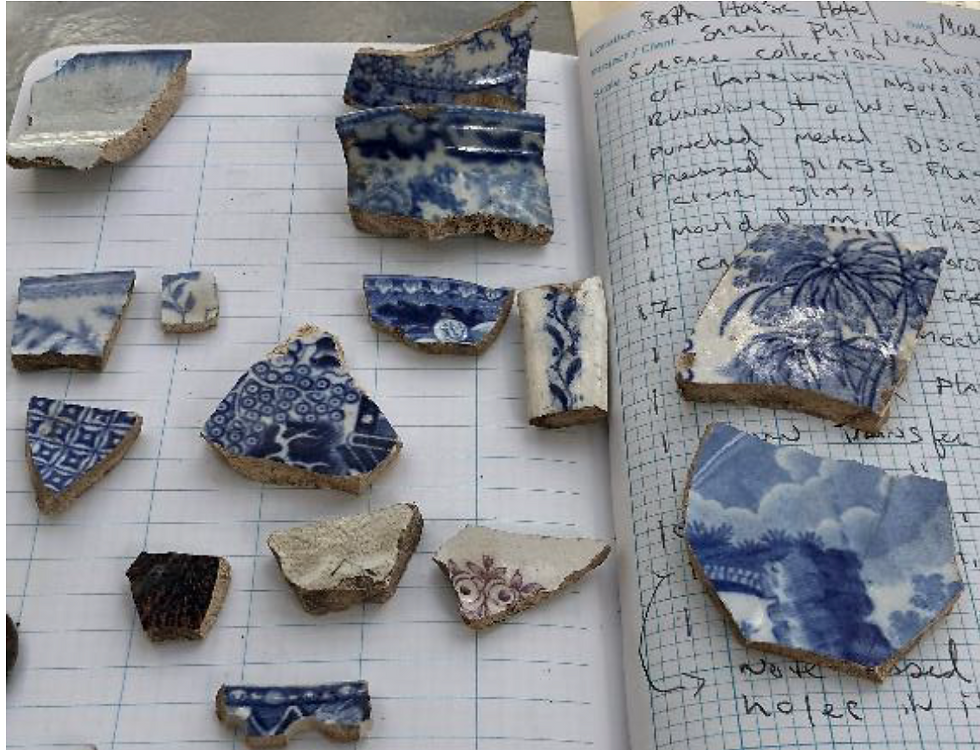
Formal archaeological investigations were undertaken on the Bath Hotel grounds in 2017 and 2018, combining archival research with modern scientific techniques. These studies included:
-
Ground-penetrating radar (GPR) surveys to identify buried architectural features and garden terraces
-
Surface artefact collection across landscaped areas
-
Test excavations to examine soil layers and material remains beneath the surface
The findings confirmed that the Bath Hotel was intentionally designed as part of a carefully planned cultural landscape, integrating the building, terraced gardens, pathways, and bathing areas into a unified experience focused on health, leisure, and social life.
Archaeological remains revealed stone retaining walls, garden terraces, and circulation routes that once guided visitors from the hotel down toward the baths and stream. These features reflect late-Georgian design principles adapted to a Caribbean volcanic landscape.
built by enslaved hands
While archival records remain incomplete, archaeological and historical evidence strongly indicates that the Bath Hotel and its surrounding landscape were constructed by enslaved Africans, using locally quarried volcanic stone. Their craftsmanship is evident in the precisely cut masonry, terracing, and drainage systems that allowed the structure to endure earthquakes, hurricanes, and centuries of use.The Bath Hotel thus stands not only as a monument to early Caribbean tourism, but also as a testament to the skill, resilience, and labour of enslaved Nevisians whose work shaped the island’s built environment.
a living archeological landscape
Unlike many historic sites, the Bath Spring-Stream is not a relic of the past. Archaeological research observed continuous, daily use of the stream by Nevisians and visitors alike—for bathing, washing, and social gathering—just as it has been used for generations. This living tradition underscores the Bath Hotel’s dual heritage: a colonial architectural landmark set within a much older, community-centred cultural landscape.