

ONSITE ARCHEOLOGY & GEOLOGY
The building which today is known as the Bath House Hotel owes its existence to the naturally occurring hot springs which flow beneath it. Thermal springs surface all over the Caribbean; indeed, Nevis is said to have a second spring, with a higher temperature than the 36 ° Centigrade recorded at Bath. The Bath spring is unique because of its historic connections which go back to the early days of colonial settlement and also because it has been exploited commercially over a long period of time. The spring at Bath led to the building of a bath house which stands on the same property as the hotel. It is not known whether this was erected at the same time as the hotel. The water of the Bath spring is rich in minerals and said to possess healing properties – both by bathing in it and by drinking it. Over four hundred years ago the first European visitors to the island recognized this although it is, of course, possible that the original inhabitants of Nevis had also enjoyed the water’s benefits. (EICKELMANN, 2017)


bath spring-stream & GAllows bay
While the colonial era construction of the buildings known as the Bath House-Hotel may date to the late eighteenth- or early nineteenth-century, community use and broader colonial knowledge of the volcanic spring flowing into the lower Bath Stream significantly pre-dates these buildings, and indeed most likely the colonial era itself. Archaeological evidence has documented Indigenous settlement of multiple Post-Saladoid era sites1 (dating after 900 A.D.) along the lower Bath Stream (Wilson 2006: 56-57; see also Ferris n.d.a), a little more than a kilometre from the Bath House-Hotel along the stream, and at Gallows Bay.
Moreover, the Reverend William Smith (1745: 57-58) notes that, at least in the early eighteenth-century, outlets of the volcanic spring could be felt below the cold waters of the Bath stream very near to Gallows Bay. So it is reasonable to assume that the documented Indigenous settlement of the lower Bath Stream would have meant those residents were aware, and used, the waters of the volcanic spring. (FERRIS, 2018)
The water of the Bath spring is rich in minerals and said to possess healing properties – both by bathing in it and by drinking it. Over four hundred years ago the first European visitors to the island recognized this although it is, of course, possible that the original inhabitants of Nevis had also enjoyed the water’s benefits. (EICKLEMANN, 2017)

ARCHEOLOGY ONSITE

Neal Ferris and team onsite at Bath Hotel, 2018
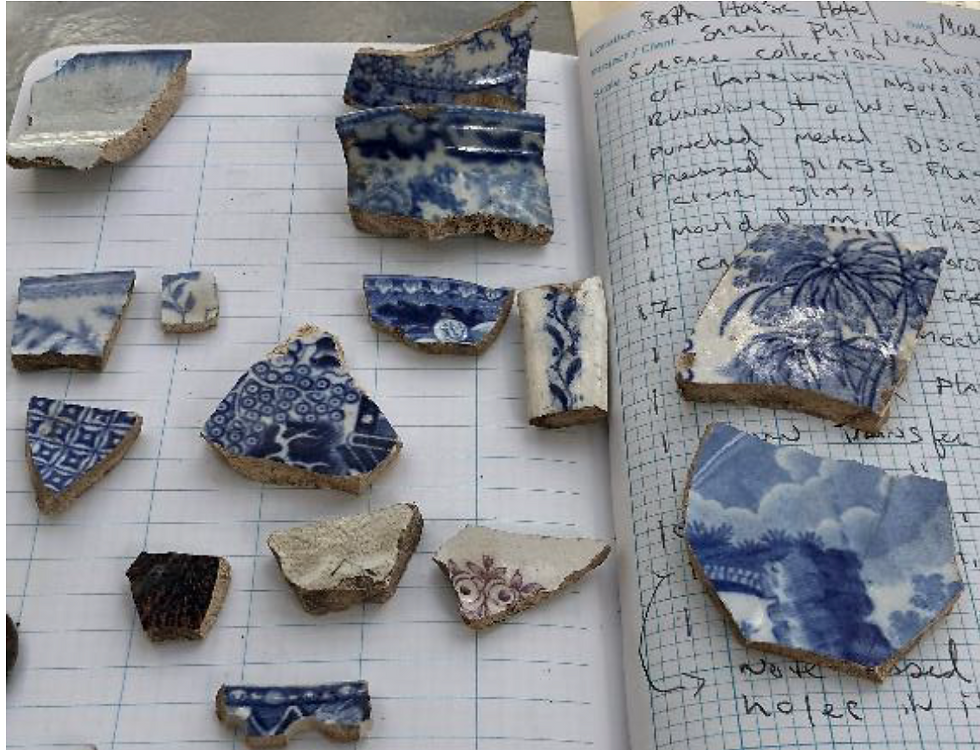
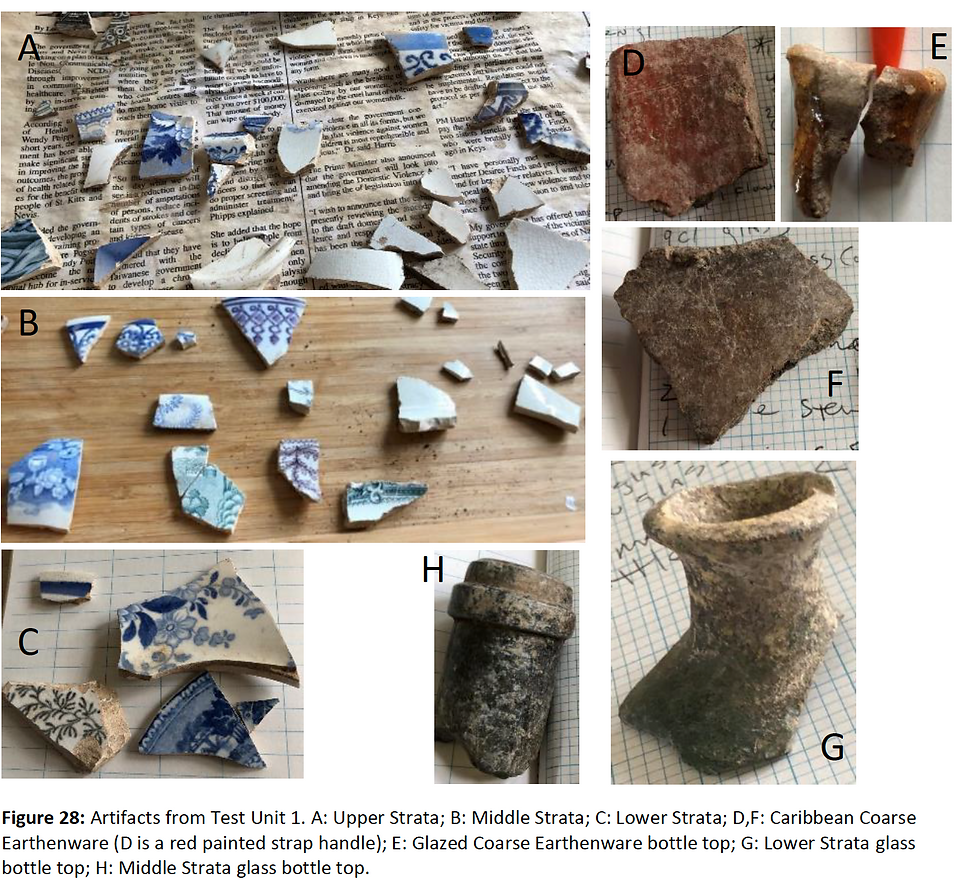
In 2018 Neal Ferris and a team comprising of Sarah Bolstridge, Edward Eastaugh, Manina Jones, and Phil Woodley conducted fieldwork and analysis at the Bath House-Hotel. This included the use of Ground Penetrating Radar (GPR) and Total Station mapping as well as test excavations and surface collections of the grounds.
Their research was made possible through a small grant in 2017 from the University of Western Ontario and the Faculty of Social Sciences and an internal SSHRB awarded for 2018-2019. The research posited that they Bath House-Hotel and Bath Spring-Stream represents a unique cultural heritage landscape, encompassing a distinct heritage of health, wellness, resort, recreation, and tourism.
The structure has remained largely intact and is a very rare non-military, non-estate and non-government building in the Caribbean. It had a long standing reputation as a place to see and be seen as well as to experience the fineries of the colonial lifestyle during British rule. (FERRIS, 2018)
CAPTAIN JOHN SMITH's VISIT in 1607
In one of the earliest known written accounts Captain John Smith in March 1607 stopped off at Nevis with colonists bound for Virginia. He recounted that "We came to a bath standing in a valley betwixt two hils (sic) where wee bathed ourselves, and found it to be of the nature of the bathes in England, some places hot, some places colder..." Manchineel trees grow along coastal fringes and Smith went on to say that many men suffered what appears to have been burns from this tree. "They … became so tormented with a burning swelling all over their bodies, they seemed like scalded men, and neere mad with paine; Here we found a great Poole, wherein bathing themselves, they found much ease, and finding it fed with a small streame that came from the woods, we found the heade half a mile within the land, distilling from a many of rocks, by which they were well cured in two or three dayes."
"...Nevis was more than peaceful; it seemed like a paradise. The men spent six days there, washing their clothes and bathing in the mineral springs, gathering an abundance of wild fruits and berries and this incidently staving off scurvy. Fish and game were plentiful, eben tropical deer, and the whole company enjoyed venison, which in England had become food primarily of the upper classes. The water they obtained in Nevis was later discarded because of a bad taste."
From the Glorious Scoundrel by Noel B. Gerson and Dodd Mead, 1978
In October 1609, two years after Smith and the colonists had stayed at Nevis, Robert Harcourt stopped off on his return journey from his colonising expedition to present-day Guyana. Wanting to take on more water before crossing the Atlantic, he knew what to expect:
In this island there is an hot bath, which, as well for the reports that I have heard, as also for that I have seen and found by experience, I do hold for one of the best and most sovereign of this world.

Add a Title
Captain John Smith

Robert Harcourt